The better device depends on whether you need to detect an object crossing a defined path or material reaching a point inside a vessel. By comparing the sensing principles, material limits, installation requirements, and process risks, you can choose the technology that fits your conveyor, hopper, silo, tank, or chute.
Key takeaways
- Use photoelectric sensing for objects crossing a beam or reflecting light.
- Use RF admittance sensing for material presence at a vessel’s level point.
- Specify dust, buildup, product dielectric properties, temperature, and mounting clearance.
- Require calibration, wiring, enclosure, and service details in Mumbai procurement documents.
What each sensor actually measures
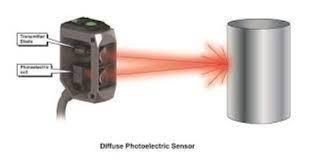
A proximity photoelectric sensor measures whether light reaches its receiver along a defined path. Its light source emits infrared or visible light, and the sensor switches when a target interrupts, returns, or reflects that light. It detects an object or surface in space, not the quantity of material inside a vessel.
| Device | What it measures | Optical or electrical arrangement | Typical result |
|---|---|---|---|
| Proximity photoelectric sensor | Object presence, position, count, or gap | Through-beam: separate emitter and receiver; retro-reflective: target returns light from a reflector; diffuse-reflective: target returns light directly to the sensor | Detects a carton, part, vehicle, or product crossing a beam |
| RF admittance level switch | Material contact or approach at a probe | Radio-frequency signal measures admittance between the probe and vessel wall or reference electrode | Indicates high level, low level, or material presence at one point |
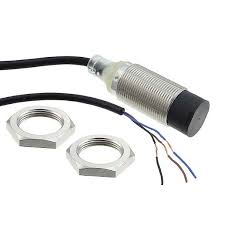
| Inductive proximity sensor | Conductive metal near its electromagnetic field | Coil creates a changing electromagnetic field | Detects metal, not a general optical target |
An RF admittance level switch measures a change in electrical admittance, which is the ease with which the material-and-vessel circuit carries the applied RF signal. The probe forms one electrode; the grounded vessel or separate reference electrode forms the other.
Material contacting or approaching the probe changes that relationship, so the switch reports level at the probe location.
Choose photoelectric detection when an object must be seen at a conveyor, chute, or process-line gap. Choose RF admittance when you need a point level inside an opaque tank, hopper, or silo containing powder, granules, slurry, or liquid.
Choose beam detection for objects and probe detection for levels
Use a proximity photoelectric sensor when you need to detect an object, gap, or moving stream at a defined point. Choose RF admittance when you need to know whether material has reached a high or low point inside a vessel.
| Application | Better choice | Reason |
|---|---|---|
| Conveyor packages or parts | Proximity photoelectric sensor | Detects presence, spacing, counting, and jams without entering the product stream. |
| Tank or process vessel | RF admittance level switch | Detects liquid, slurry, powder, or granules at a probe location inside an opaque vessel. |
| Hopper or silo | RF admittance level switch | Provides high-level or low-level indication without requiring a clear optical path. |
| Chute or enclosed transfer point | Depends on the decision | Use photoelectric detection for visible flow across the chute; use RF admittance for material reaching a defined buildup or backup point. |
| Process line | Depends on the target | Use photoelectric detection for parts and packages; use RF admittance for bulk material contacting a probe. |
A through-beam proximity photoelectric sensor is the stronger conveyor choice when dust, target colour, or surface finish could weaken reflection, provided you can align an emitter and receiver on opposite sides. A proximity sensor becomes the wrong tool when the target is hidden inside an opaque hopper or silo.
RF admittance is the better choice for point level, not continuous inventory measurement. Place its probe at the exact alarm or control height; moving it changes the level being detected. A photoelectric unit needs an unobstructed beam or a clean optical window, while RF admittance does not depend on visible access.
How dust, product properties, buildup, and light affect reliability
Dust, buildup, product properties, and ambient light decide whether each sensor switches cleanly or chatters. A photoelectric sensor needs a usable optical path; an RF admittance level switch needs a stable electrical relationship between its probe, the material, and the vessel.
Dust clouds scatter or absorb light, causing weak detection or missed objects. Dust on the lens reduces received signal, while sunlight, welding arcs, or nearby lamps can create false switching. Dark, transparent, reflective, or irregular targets also change the returned light, especially with diffuse-reflective sensing.
An RF admittance level switch is not affected by optical opacity, so it suits powders, granules, slurries, and liquids inside enclosed equipment. Product moisture and dielectric constant still matter: a damp powder can trigger at a different probe distance than a dry powder.
A low-dielectric plastic pellet may produce a weaker response than a conductive liquid.
| Condition | Photoelectric result | RF admittance result |
|---|---|---|
| Dust cloud or opaque product | Scattered beam, missed detection | Usually unaffected at the probe |
| Lens or probe coating | Lens causes weak or false optical signal | Coating can cause false level unless a driven shield and coating compensation are used |
| Shiny, dark, transparent target | Unstable reflected signal | Material response depends on dielectric properties |
| Product buildup | Blocks the beam or changes reflection | Can cause false high level; tune for coating or clean the probe |
A capacitive proximity switch shares RF sensing principles but lacks the vessel-level features of an RF admittance level switch in many designs. Treat it as a short-range object sensor, not an automatic substitute for a buildup-prone silo application.
Installation details that decide whether the choice works
Verify the installation before choosing the device: a proximity sensor needs a controlled optical path, while an RF admittance level switch needs a correctly located probe and electrical reference.
1. Confirm the sensing distance. Keep a photoelectric sensor within its specified operating range, with margin for target colour, reflectivity, and lens contamination; include the reflector distance for a retro-reflective model. For an RF admittance level switch, confirm the probe length and switching point against the required high- or low-level location.
2. Check alignment and position. Aim the photoelectric emitter and receiver squarely across the detection path, and prevent vibration from moving either unit. Install the RF probe away from the fill stream, agitator, outlet, and vessel wall; those locations can cause impact, bridging, or false switching. Leave clearance from internal metalwork.
3. Establish grounding and separation. Bond a conductive vessel to the sensor’s specified reference ground, and follow the manufacturer’s arrangement for non-metallic vessels or a reference electrode. Separate the probe and photoelectric housing from other sensors, motors, heaters, and metal supports that can alter the field or block the beam.
4. Route cables away from motor, VFD, and high-current wiring; cross such cables at 90 degrees where they must intersect. Verify temperature, pressure, ingress protection, chemical compatibility, and hazardous-area approval. Use a certified safety sensor and safety-rated control circuit for guarding or personnel protection; an ordinary proximity sensor is not a safety device.
What to put in a Mumbai procurement specification
State the application before naming the device. For a proximity photoelectric sensor or RF admittance level switch in Mumbai, local climate alone is not the deciding factor; dust, washdown, product buildup, vessel geometry, and temperature determine the specification.
Give the supplier these details:
- Target material, particle size, colour, moisture, dielectric behaviour, bulk density, and whether it sticks to the probe or lens.
- Conveyor speed, object size, sensing distance, beam position, or vessel diameter and required high- or low-level point.
- Ambient and process temperature, pressure, vibration, washdown chemicals, dust concentration, and required enclosure rating such as IP65 or IP67.
- Supply voltage, permissible current, PNP or NPN output, normally open or normally closed logic, relay or analogue output, cable length, connector, and load type.
- Process connection, probe length, insertion direction, vessel material, reference ground, and hazardous-area classification where applicable.
- Whether the function is ordinary automation or personnel protection. A standard photoelectric sensor is not a machine-safety device; specify a certified safety sensor and safety-rated control system for that duty.
| Option | Specify when | Main limitation |
|---|---|---|
| Photoelectric | External object, gap, or conveyor presence | Needs a clean, aligned optical path |
| RF admittance | Enclosed tank, hopper, silo, powder, granule, slurry, or liquid level | Requires correct probe, grounding, and process connection |
| Capacitive proximity switch | Short-range detection with stable material and little buildup | Unsuitable for coating-prone level service where driven-shield compensation is needed |
Give SAI CONTROL SYSTEM this complete information rather than requesting a generic “level sensor.”
Related products
 | Proximity Sensor Proximity Photoelectric Sensor The Proximity Photoelectric Sensor from Sai Control Systems is a high-efficiency sensing device engineered specifically for demanding industrial... View product → |
 | Proximity Switches The Omron Proximity Switch is a robust and dependable sensing device designed to deliver accurate object detection across a wide range of industrial... View product → |
Frequently asked questions
What does a proximity photoelectric sensor actually measure?
It measures whether emitted light reaches, returns from, or reflects off a target, so it detects objects or surfaces in space.
What does an RF admittance level switch measure?
It detects a change in electrical admittance between its probe and the vessel or reference ground when material reaches the sensing point.
When should you choose beam detection instead of probe detection?
Choose beam detection for counting, positioning, or detecting objects on a conveyor. Choose a probe-based level switch for high, low, or point-level detection inside a vessel.
How do dust, buildup, product properties, and light affect sensor reliability?
Dust and optical contamination can block or scatter a photoelectric beam, while probe buildup and changing product dielectric properties affect RF admittance switching.
What installation details belong in a Mumbai procurement specification?
State the sensing task, range, material, temperature, dust conditions, mounting, output, supply voltage, enclosure rating, cable entry, calibration method, and commissioning requirements.
Related products
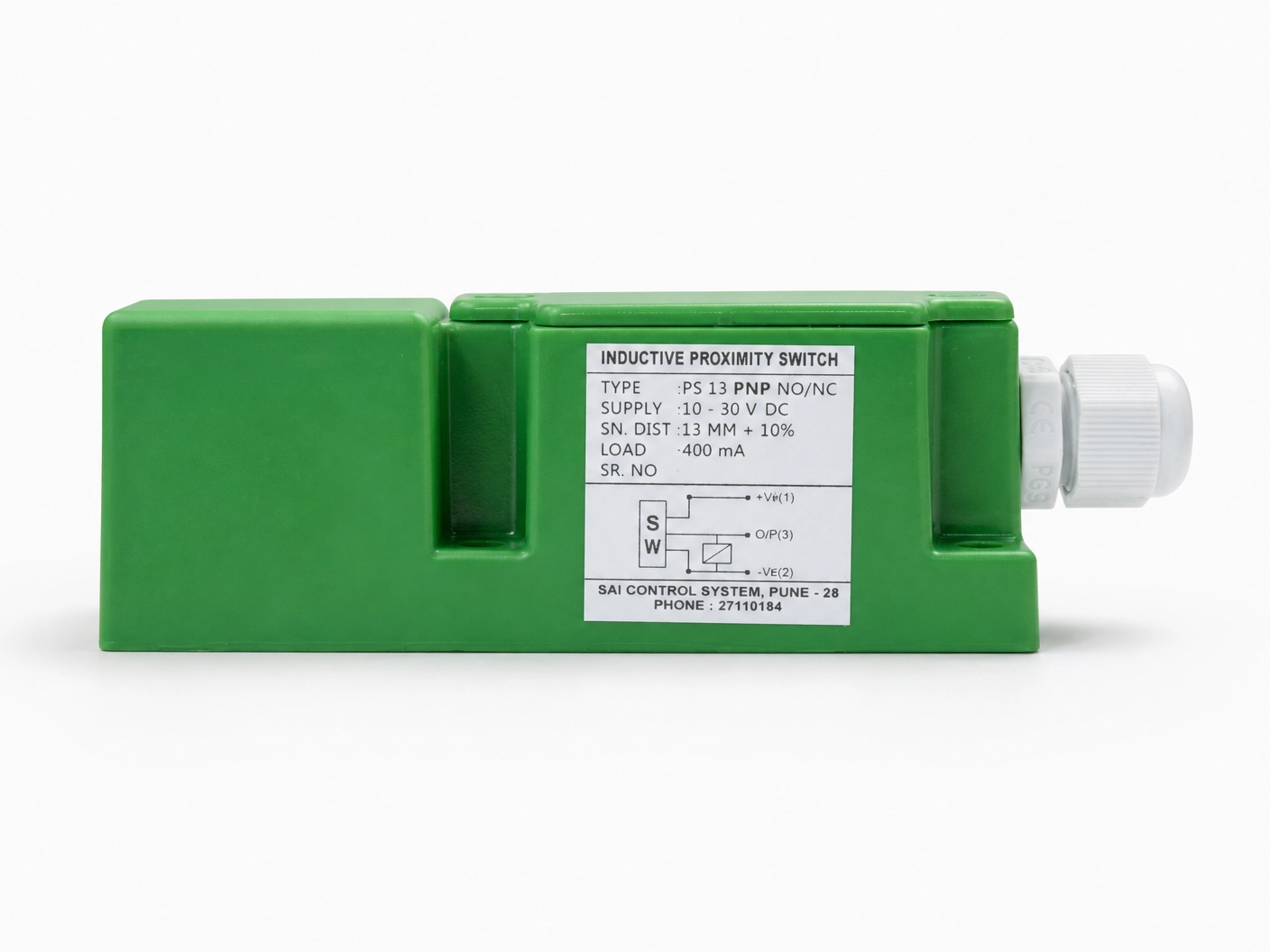 | Inductive Proximity Sensor Model: IPS13PNODF40 Size : 40*40*112mm Logic : PNP NO Sensing Distance : 15mm Sensing Face : Front Connection : PG Gland View product → |
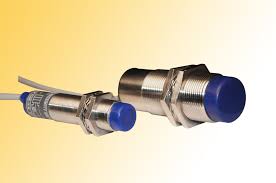 | Inductive Proximity Sensor The Inductive Proximity Sensor from Sai Control Systems is a vital component for modern industrial automation, offering non-contact metal detection... View product → |
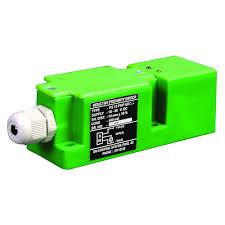 | Inductive Proximity Sensor Square Type Inductive Proximity Sensor The Square Type Inductive Proximity Sensor from Sai Control Systems is a high-performance, non-contact sensor designed for efficient and reliable... View product → |
 | Proximity Sensor Sai Control Systems offers a high-performance Capacitive Proximity Sensor designed to detect a wide range of materials including plastic, glass,... View product → |