A conveyor can remain stopped even when a light curtain shows a clear field, while a pull cord lamp can glow without proving that the emergency-stop circuit has opened. By separating optical faults, safety-controller faults, and indication-circuit faults, you can test the system in the correct order and specify replacement equipment without guessing.
Key takeaways
- Check OSSD status before replacing a light-curtain sensor.
- Test pull-cord lamp wiring separately from safety contacts.
- Inspect rope tension, alignment, reset circuits, and terminal connections.
- Prove the repair with documented trip and reset tests.
Separate a light-curtain fault from a pull-cord trip
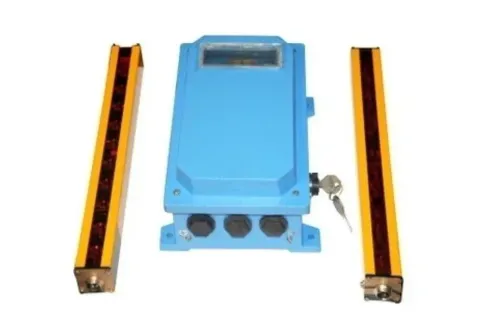
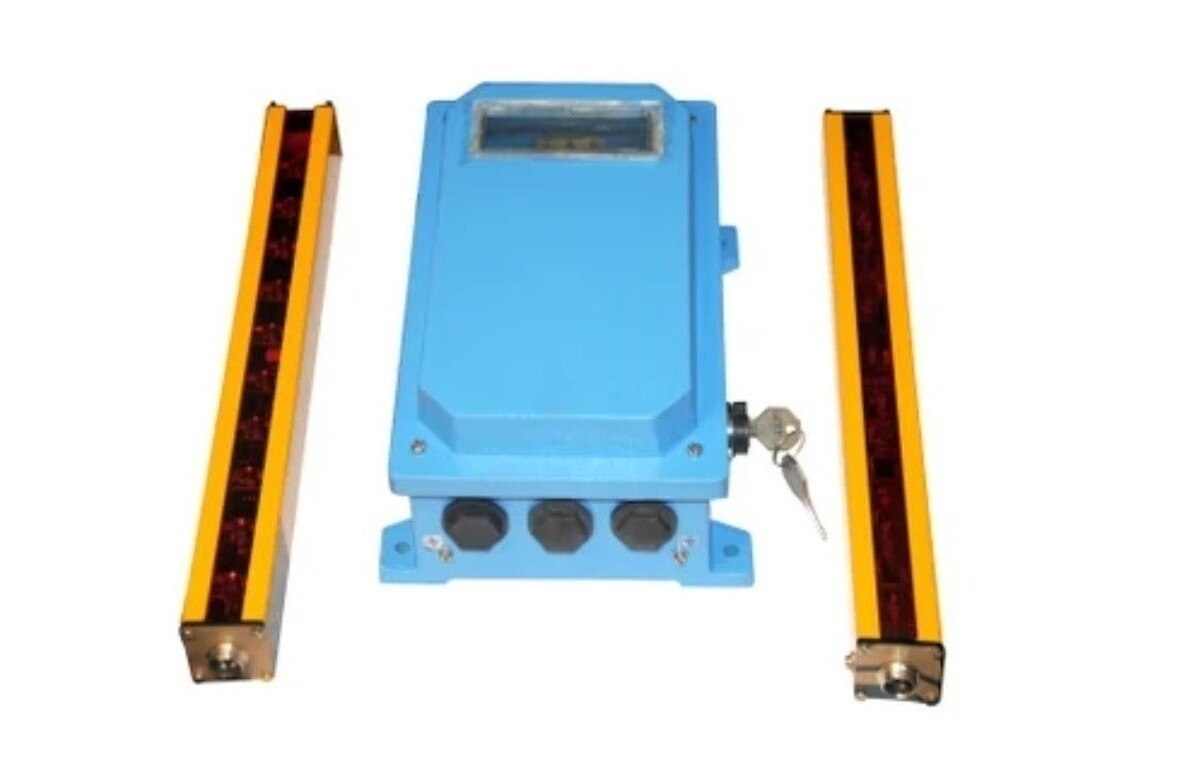
An interrupted beam and a pulled rope are different stop commands. A safety light curtain detects entry into a guarded zone: its transmitter and receiver monitor the beam field, then place the OSSD outputs in the safe state when a beam is blocked or the curtain detects an internal fault.
A pull-cord switch detects a manually initiated conveyor emergency stop and mechanically latches its safety contacts after the rope is pulled.
| Device | What it detects | What can stop the conveyor |
|---|---|---|
| Safety light curtain | A person or object entering the protected field, plus curtain or supply faults | The safety relay or safety PLC sees unsafe OSSD outputs and removes the run command |
| Pull-cord switch | A deliberate rope pull along the conveyor | The safety circuit opens through its latched contacts and removes the run command |
| Indicator lamp | A wired status signal, such as healthy, tripped, or reset | Nothing by itself; it does not prove that the motor contactor has dropped out |
The device shown in the fault indication is not automatically the device stopping motion. Check the OSSD state at the safety relay or PLC input, then check the pull-cord safety contacts and reset circuit. A permanently lit curtain “clear” indicator can coexist with an open machine-side circuit.
Likewise, a pull-cord lamp can be dark because of its supply or wiring while the conveyor remains safely stopped. This distinction matters when investigating safety light curtain problems in mumbai or a pull-cord lamp fault.
Find the light-curtain fault before replacing the sensor
A clear sensing field does not prove that the conveyor can run. Most safety light curtain faults appear in the diagnostic display before any component needs replacement.
1. Stop the machine under your site’s isolation procedure and read the curtain’s fault code. If it reports a blocked beam, remove the object, then clean both optical faces with a lint-free cloth. Check emitter-receiver alignment, vibration, correct pairing, and any cable damage.
A clear field with a persistent block indication points to alignment, contamination, or an optical fault.
2. Check the transmitter and receiver supply at their terminals; confirm the specified 24 VDC range rather than assuming the panel supply is correct. With the field clear, measure both OSSD outputs against the manufacturer’s truth table.
One channel stuck low, an open conductor, a short between channels, or reversed wiring identifies an OSSD circuit fault. Do not bridge the outputs to force a run.
3. If both OSSD channels show the safe or run state but the conveyor remains inhibited, inspect the manual-reset input, external-device-monitoring feedback, safety relay, and safety PLC diagnostic bits. A contactor feedback loop that never returns, an uncompleted reset, or controller communication fault can hold the machine stopped without a failed curtain.
If you are sourcing a pull cord switch for lamp in Mumbai, record the fault code and measured states first. Replacing the sensor without that evidence can leave the actual reset or controller fault untouched.
Diagnose the pull-cord lamp and safety contacts separately
Record the symptom before opening the enclosure. For pull cord switch lamp fault diagnosis, treat the lamp as an auxiliary indication circuit, not as evidence that the emergency-stop contacts have operated. A lit lamp cannot prove that the safety relay dropped out or the conveyor stopped.
- Lamp off while the safety circuit is healthy: measure voltage at the lamp terminals, then check the fuse, LED polarity, voltage rating, and loose terminals.
- Lamp on after a trip: confirm whether the lamp is wired for tripped or healthy status, then test the selected auxiliary contact.
- Lamp flickering: inspect terminal tightness, cable movement, contact bounce, vibration, and an unstable control supply.
- Lamp shows healthy while the machine is stopped: check whether the indication is controlled by a reset output rather than by actual safety-contact status.
Test the safety contacts independently with power isolated and the switch in its normal and pulled positions. Verify positive-opening contact operation, continuity changes, and the corresponding safety-controller inputs; a failed contact block or wrongly selected auxiliary contact can leave the lamp apparently correct.
Then test reset logic. Pulling the cord must latch the switch, open the safety circuit, and require a separate manual reset; releasing the cord or resetting the switch must not restart the conveyor.
If the lamp voltage and contact operation are correct but its state is wrong, trace the controller’s indication output and reset feedback wiring. Record each terminal voltage and contact state rather than replacing the complete switch.
Correct installation errors and prove the repair
Recurring faults usually come from installation, not a defective device: loose curtain brackets, misaligned emitter and receiver, incorrect protective distance, poor 24 VDC wiring, slack rope, seized pulleys, or a lamp circuit mistaken for the safety circuit. Inspect seals, glands, condensation, corrosion, optical windows, terminal tightness, and supply voltage while the conveyor is running.
| Error | Result | Correction |
|---|---|---|
| Loose or misaligned curtain | Beam faults return after vibration | Secure brackets and align the emitter and receiver; recalculate stopping distance and reach-through protection |
| Incorrect OSSD, EDM, reset, or supply wiring | Curtain appears clear but the controller will not permit restart | Verify both OSSD channels at the safety relay or safety PLC, including 24 VDC voltage under load |
| Slack rope, excessive tension, seized pulley, or unsupported span | Pulling fails to open both safety contacts | Use the specified rope length, support spacing, tension, travel, temperature range, and covered pull directions |
| Broken gland, contaminated lens, or wet switch | Intermittent trips vanish during a bench test | Restore enclosure sealing, clean the windows, and replace damaged cable or hardware |
Prove the repair in this order:
- Isolate energy, inspect the complete route, and correct mechanical faults.
- Interrupt every curtain beam; confirm both OSSD channels reach the safe state.
- Pull the rope at each required direction and location; confirm both safety contacts open.
- Check that the lamp indication changes as designed, but test its auxiliary circuit separately.
- Release the rope, clear the curtain, reset the safety circuit, and verify controlled restart.
- Operate the conveyor under load; confirm stopping time, fault logging, and no automatic restart.
Specify the right pull-cord switch for the application
A replacement must match the conveyor’s safety circuit, not merely its mounting holes. Give a pull cord switch with lamp indication supplier the conveyor length and layout, switch quantity and spacing, rope direction, support points, and the required maximum rope length.
Send these details with the enquiry:
- State the required safety function: Category 3 or 4, or Performance Level d or e under ISO 13849-1, and the proof-test method used after installation.
- Identify the control voltage, safety-contact arrangement, positive-opening requirement, contact rating, reset type, and whether contacts feed a safety relay, safety PLC, or contactor circuit.
- Specify the enclosure rating, cable-entry size and direction, ambient temperature, dust, water, vibration, corrosion, and hazardous-area classification if applicable.
- Define the lamp behavior: healthy, tripped, or reset indication; lamp voltage; LED polarity; and whether it receives continuous power or switches through an auxiliary contact.
- Provide the rope diameter, tension range, allowable travel, support spacing, pulley arrangement, and the direction from which a pull must actuate the switch.
Ask for the manufacturer’s wiring diagram and confirmation that the safety contacts and lamp circuit are independent. A lit lamp cannot prove that the safety circuit opened.
A pull cord switch manufacturer in Mumbai, including SAI CONTROL SYSTEM, needs these facts to avoid supplying an electrically incompatible indicator or a switch that cannot cover the conveyor geometry.
Related product
 | Pull Cord Switch Pull Cord Switch With Lamp Indication The Pull Cord Switch with Lamp Indication is a premium-grade control switch designed to enhance safety and convenience in industrial and commercial... View product → |
Frequently asked questions
How do you distinguish a light-curtain fault from a pull-cord trip?
Check the light curtain’s OSSD status and beam indicators, then test the pull-cord switch’s safety contacts and lamp circuit separately. An interrupted beam and a pulled rope generate different stop signals.
What should you check before replacing a light-curtain sensor?
Inspect transmitter-receiver alignment, beam obstruction, power supply voltage, OSSD wiring, connector condition, and diagnostic indicators before replacing the sensor.
Why can a pull-cord lamp fail while the safety contacts still work?
The lamp uses a separate indication circuit. A failed lamp, loose terminal, incorrect supply voltage, broken wire, or blown fuse can disable the indication while the safety contacts remain operational.
How do you prove a repaired light curtain or pull-cord switch is safe?
Test every beam interruption, pull-cord trip, manual reset, emergency-stop response, and restart interlock, then record the results against the machine’s safety procedure.