A fixed-voltage switch costs less, but it cannot respond when hopper pressure, material behaviour, or downstream speed changes. By comparing operating costs, electrical compatibility, control signals, and commissioning results, you can decide whether a controller will pay for itself on your Pune production line.
Key takeaways
- Compare installed cost with rejects, jams, labour, and empty downstream cycles.
- Calculate payback from measured losses, not the controller purchase price alone.
- Match controller output, feeder load, voltage, frequency, and operating mode.
- Prove results using throughput, reject rate, stoppages, and intervention records.
When Does Controlled Feeding Justify the Extra Cost?
A linear vibrator controller is worth the cost when unstable feeding creates measurable loss. Ask: is a linear vibrator controller worth it for feeders in pune? Compare rejects, jams, operator intervention, and empty downstream cycles with the controller’s installed cost, not its purchase price alone.
| Option | What it means | When it applies |
|---|---|---|
| Manual voltage control | Operator adjusts a potentiometer or voltage setting | One feeder, stable material, one operator, and little consequence from overfeeding |
| Fixed-speed switch | Feeder runs at one preset output | Simple duty where hopper pressure and bulk density remain stable |
| Relay control | Feeder starts or stops on a discrete signal | Basic machine interlock, but no continuous rate correction |
| PLC-based control | PLC sets output through 0–10 V, 4–20 mA, pulse, or discrete commands | Packaging, inspection, or multi-shift lines needing repeatable parts per minute |
Controlled electromagnetic feeding earns its cost when hopper head pressure changes, bulk density varies, or a packaging machine demands a steady rate. It also helps when overfeeding causes rejects, jams, product damage, or empty cycles. The linear vibrator controller benefits in pune include fewer operator adjustments, steadier feed rates, fewer stoppages, and faster product changeovers.
A variable-frequency drive is not a drop-in replacement. Most standard 50 Hz linear electromagnetic feeders need amplitude control at their designed frequency; changing frequency can reduce stroke or overheat the drive. The automatic feeder control advantages in pune are strongest when avoided instability and intervention cost more than installation, wiring, commissioning, and service.
How Do You Calculate Payback From Feeder Control?
The question is simple: is a linear vibrator controller worth it for feeders in pune? Compare measured monthly losses with the complete installed cost, not the controller’s purchase price.
1. Record a baseline across several representative shifts: kilograms or parts fed, rejected or damaged units, stoppage minutes, operator interventions, changeover time, compressed-air use for correcting poor flow, and the value of lost production.
2. Calculate monthly net savings with this formula: avoided rejects and material waste + labour saved from manual adjustment and jam clearing + avoided feeder and line downtime + reduced compensating compressed-air cost − added maintenance and energy cost.
3. Divide the installed investment by monthly net savings to estimate payback in months. Include installation labour, panel modifications, wiring, sensors, commissioning, spare-controller availability, and local service response in that investment figure.
A premium controller is difficult to justify for one stable, manually adjusted feeder with little consequence from overfeeding. The linear vibrator controller benefits in pune become easier to defend on a multi-shift packaging, inspection, press, or robotic line where every jam, intervention, and changeover carries a measurable cost.
Do not claim savings from higher throughput unless the feeder’s springs, payload range, mounting, and downstream machine can support it. Extra vibration cannot make an undersized feeder deliver more material reliably; it can create bounce, bridging, product damage, or downstream overload instead.
If the baseline shows negligible waste, downtime, and labour cost, retain the simpler control.
Which Controller and Feeder Specifications Must Match?
A wattage match does not prove compatibility. For a vibrator feeder controller for factories in Pune, require the feeder make and model, electromagnetic coil voltage, continuous and starting current, designed operating frequency, feed-rate range, duty cycle, and one-coil or multi-coil arrangement.
- Measure the actual supply at the machine: 230 V, 50 Hz where applicable, earthing, voltage variation, and available fault level. Do not assume identical power quality at every machine point.
- Check controller minimum and maximum output, ambient-temperature rating, enclosure derating, IP rating, humidity, condensation, cable glands, cooling fans, and exposure to washdown chemicals.
- Match the mechanics: spring condition and orientation, mounting stiffness, payload range, stroke, anchor bolts, chute clearance, and material buildup.
| Specification | Why it matters | Failure when ignored |
|---|---|---|
| Electrical rating | Current and frequency must suit the coil | Thermal trips or unstable amplitude |
| Environment | Temperature, humidity, IP protection and glands must suit the site | Condensation, dust or washdown damage |
| Mechanical tuning | Springs, payload and mounting determine resonance | More output creates noise, bounce or little extra flow |
| Control arrangement | One-coil or multi-coil design must match wiring | Incorrect operation or unsafe modification |
Pune’s monsoon humidity makes condensation control important; review sealed panels, breathers or heaters where the installation demands them. Linear feeder controller selection in Pune should also include wiring diagrams, settings, fault behaviour, and test records.
SAI CONTROL SYSTEM can be compared with other suppliers when its quotation documents these details instead of stating only nominal power.
Related products
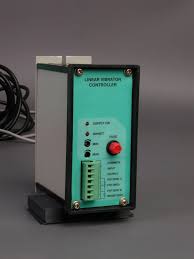 | Vibrator Feeder Controller Acknowledged as a genuine and trusted company in the industry, we are committed to offering a superior range of Linear Vibrator Controllers tailored... View product → |
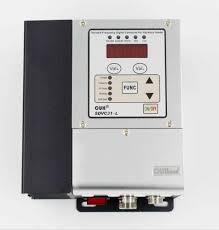 | Vibrator Feeder Controller SDVC31-L Vibrator Feeder Controllers The SDVC31-L Vibrator Feeder Controller is a high-performance digital controller designed to regulate the amplitude and feeding speed of... View product → |
How Should You Set and Integrate the Controller?
Commission the feeder in sequence: prove movement without material, establish stable pickup, then connect production signals. This avoids bounce, bridging, double feeding, and empty strokes.
1. Run the feeder with no load. Check spring orientation, anchor bolts, mounting stiffness, chute clearance, and material buildup. Set the lowest amplitude that moves material consistently.
2. Add material and increase starting speed until reliable pickup occurs. Set maximum speed below the point where parts bounce, bridge, or double feed. Adjust acceleration so the feeder reaches rate without an initial surge.
3. Repeat the test with the hopper nearly empty and nearly full. Head pressure changes the feed rate, so a setting that works at one level can cause overfeeding or empty strokes at the other.
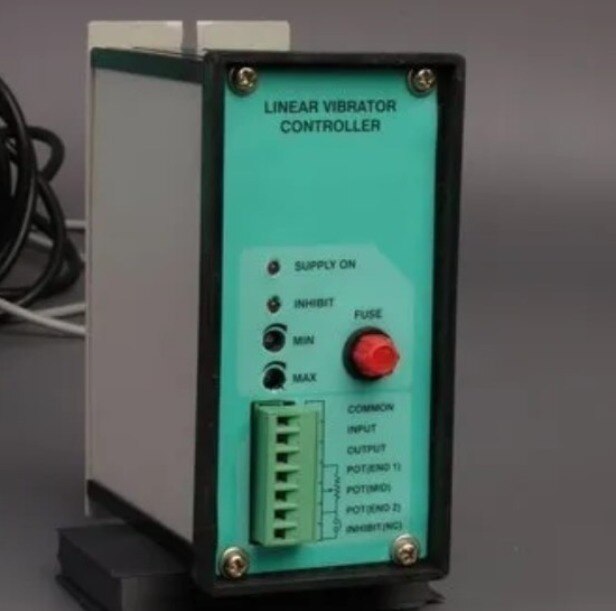
4. Define the interface before wiring. Confirm whether the controller accepts a discrete run or enable input, 0–10 V, 4–20 mA, pulse, or another speed reference, and whether it provides a fault relay or transistor output.
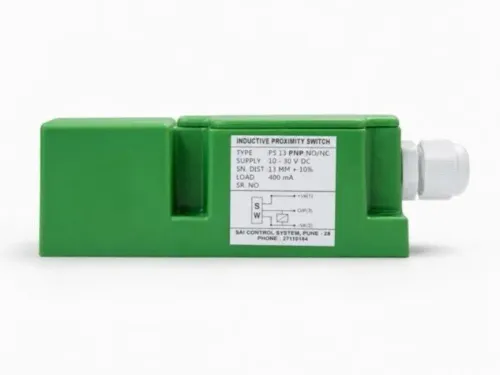
A PLC output or level sensor can start and stop feeding; a photoelectric or proximity sensor can count or release parts; a load cell, scale, or part-counting sensor can regulate flow.
5. Use closed-loop feedback for changing material or a required kilograms-per-hour or parts-per-minute rate. An open-loop knob controls vibration, not guaranteed output. These are key automatic feeder control advantages in pune and explain the value of a vibrator feeder controller for factories in pune.
6. Treat run as an operating command, never an emergency stop. Use the machine safety circuit to remove hazardous energy and control restart after a fault or power restoration.
What Evidence Shows the Investment Works on the Line?
Approve the purchase only after a documented line trial proves repeatable output and measurable savings. This is where linear vibrator controller benefits in Pune become evidence rather than a claim: count parts per minute or weigh kilograms per hour, not sound or visible stroke.
| Trial condition | Record |
|---|---|
| No-load and normal load | Start-up, steady rate, thermal trips |
| Minimum and maximum hopper levels | Feed rate and variation |
| Product changeover | Minutes, rejects, operator adjustments |
| Downstream conveyor or packaging interlock | Stop, restart, and empty strokes |
| Recovery after a stop | Time to stable rate and fault behaviour |
During linear feeder controller selection in Pune, inspect for unstable low-output regulation, audible hum, conducted noise affecting PLCs, weighing equipment, vision systems, or nearby variable-frequency drives. Check that chutes and guards never touch the vibrating assembly.
Compare each result with the baseline:
- Reject rate and material loss
- Jam-clearing minutes and operator interventions
- Changeover duration and empty strokes
- Achieved feed-rate variation
- Actual production rate
Require a handover pack listing the feeder model, coil voltage and current ratings, operating settings, wiring diagram, signal definitions, fault behaviour, IP rating, temperature limits, and spare-part details. Accept the investment when repeatable flow removes measurable losses within the expected payback period.
Reject the business case when mechanical tuning, unstable material, or downstream capacity remains the real constraint.
Frequently asked questions
When does controlled feeding justify the extra cost?
Controlled feeding earns its cost when unstable flow creates measurable rejects, jams, operator intervention, or empty downstream cycles. Compare those losses with the complete installed cost.
How do you calculate payback from feeder control?
Measure the current monthly cost of rejects, downtime, labour, and missed production. Divide the controller’s installed cost by the monthly saving achieved after installation.
Which controller and feeder specifications must match?
Check the feeder’s rated voltage, current, power, frequency, load, stroke requirements, and control method against the controller’s output specifications before purchase.
What evidence shows the investment works on the line?
Compare matched production runs before and after installation using throughput, reject rate, jam frequency, downtime, empty cycles, and operator interventions.